Front office areas and service counters: ergonomics, accessibility and flow management for Public Administration
Public Administration front office areas represent the first point of contact between citizens and institutions. In these spaces, furniture must ensure maximum accessibility, service continuity, safety and visual order. Modular counters, resistant waiting seating, separation systems and flow management solutions help create efficient and easily readable environments, improving the user experience and supporting the work of operators.The front office for Public Administration is an operational space dedicated to welcoming, information and managing the relationship with citizens. It can include service counters, organised waiting areas, seating, dividers, signage, information totems and operational workstations for staff. It helps make the service more accessible, orderly and efficient, improving orientation, privacy and continuity of daily activities.

Compact front office for single counter
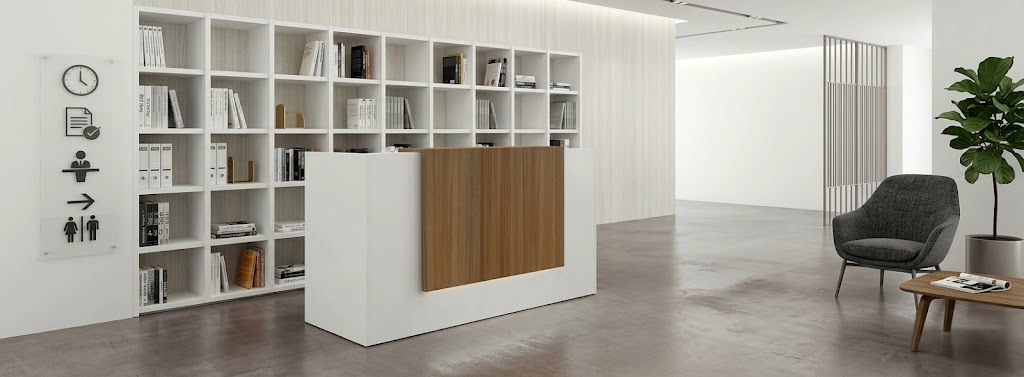
An essential space can still offer clarity, order and institutional authority.
This configuration is ideal for small municipal offices, decentralised branches, neighbourhood offices or services with a single counter operator. The project develops around a compact front office counter, a well-organised operational workstation and a small waiting area with few seats clearly integrated into the space. It is an effective solution when the priority is to give citizens an immediate and recognisable point of reference, avoiding the impression of an improvised office or a simple adapted desk. Even in limited floor areas, a well-calibrated front office improves service understanding, operator comfort and the perceived quality of the institution.

Multi-counter front office
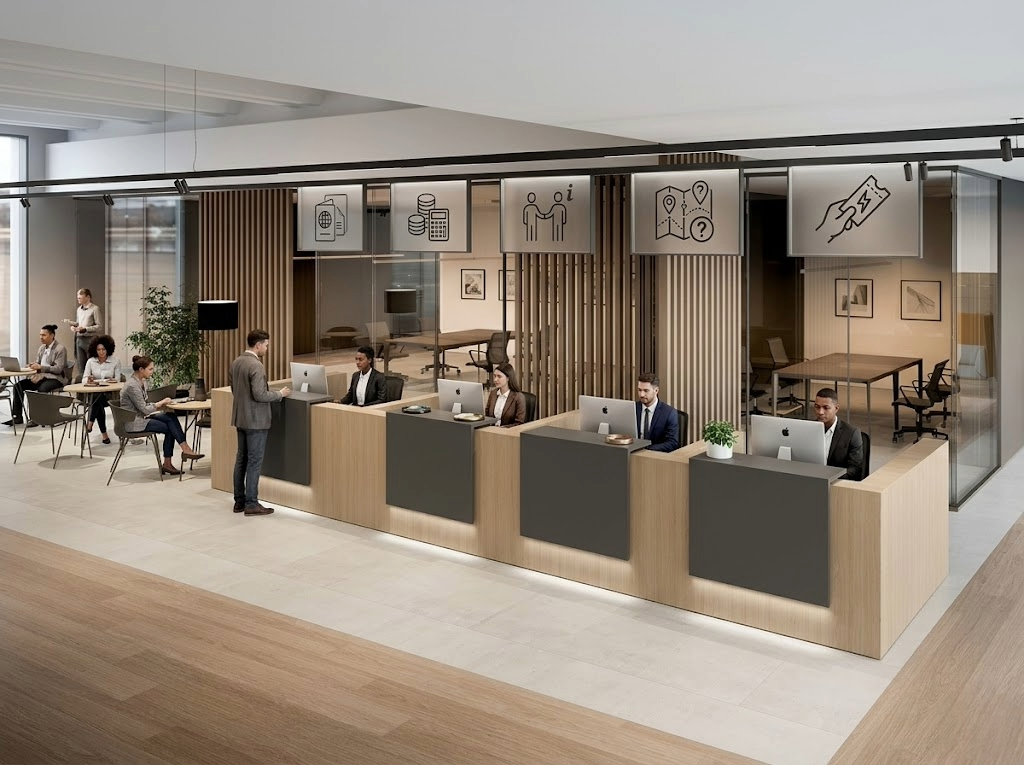
When users increase, a system is needed that remains readable and orderly.
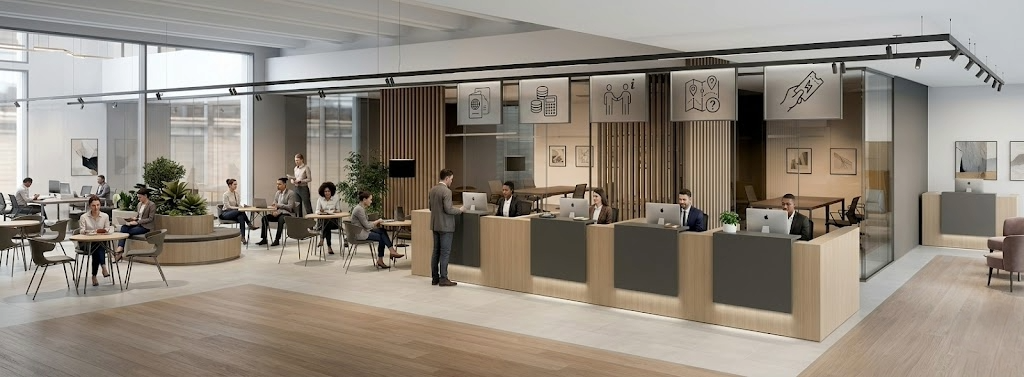
The multi-counter front office is designed for Public Administration offices with higher footfall, multiple operators and differentiated services. In these cases, the best solution is a composition with modular desks or linear counters that make it possible to organise several contact points while maintaining visual uniformity, functional clarity and ease of orientation. It is particularly useful for registry offices, tax offices, citizen services or multi-purpose counters, where the layout must help distinguish activities without creating confusion. When the system is well designed, the front office appears more efficient, staff work with greater continuity and users immediately perceive a more reliable structure that is easier to use.
Welcoming area with guided waiting
Good waiting management reduces tension, repeated questions and disorientation.
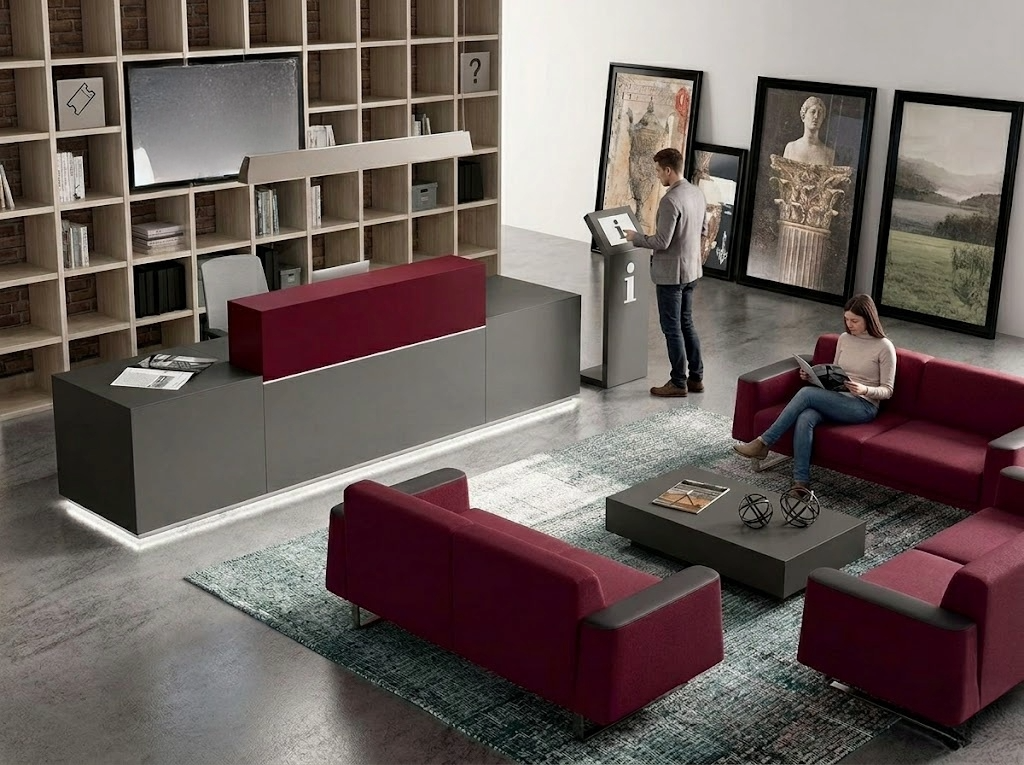
In many Public Administration spaces, the real issue is not only the service counter, but the way users experience waiting. A welcoming area with guided waiting helps make the experience more orderly through well-distributed seating, readable routes, coherent signage and, where useful, call systems or visible information points. This configuration is very effective because it lowers the perceived sense of crowding and communicates better service organisation. For citizens, it means understanding more easily where to stand, when to wait and whom to contact; for the institution, it means relieving the front office from continuous orientation requests and improving the overall quality of interaction.
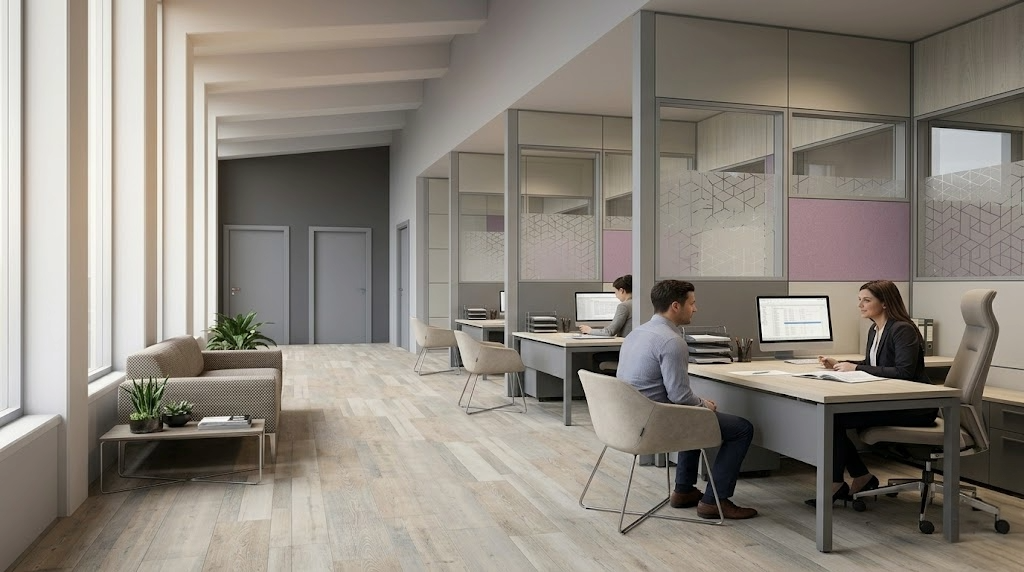
Front office with integrated privacy
Some services require welcoming, but also discretion and protection of the conversation.
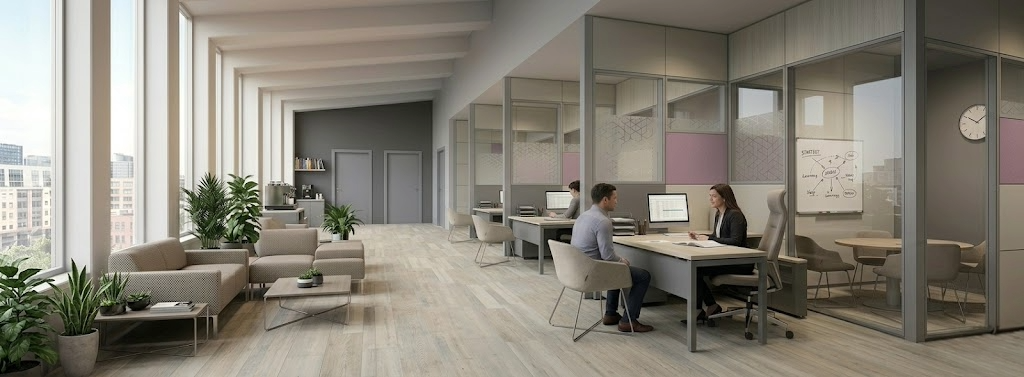
When the front office manages sensitive procedures, personal information or discussions that require greater confidentiality, it becomes essential to work on screens, correct distances, divider panels and a more careful organisation of the relationship between operator and user. This type is particularly suitable for social services, school offices, employment counters, tax offices, delicate administrative procedures and, in general, all situations where service clarity must coexist with a good level of visual and acoustic privacy. The advantage is very concrete: the space remains open and accessible, but offers a more protected and professional relational quality, reducing the discomfort of those who need to disclose personal needs or sensitive documentation.
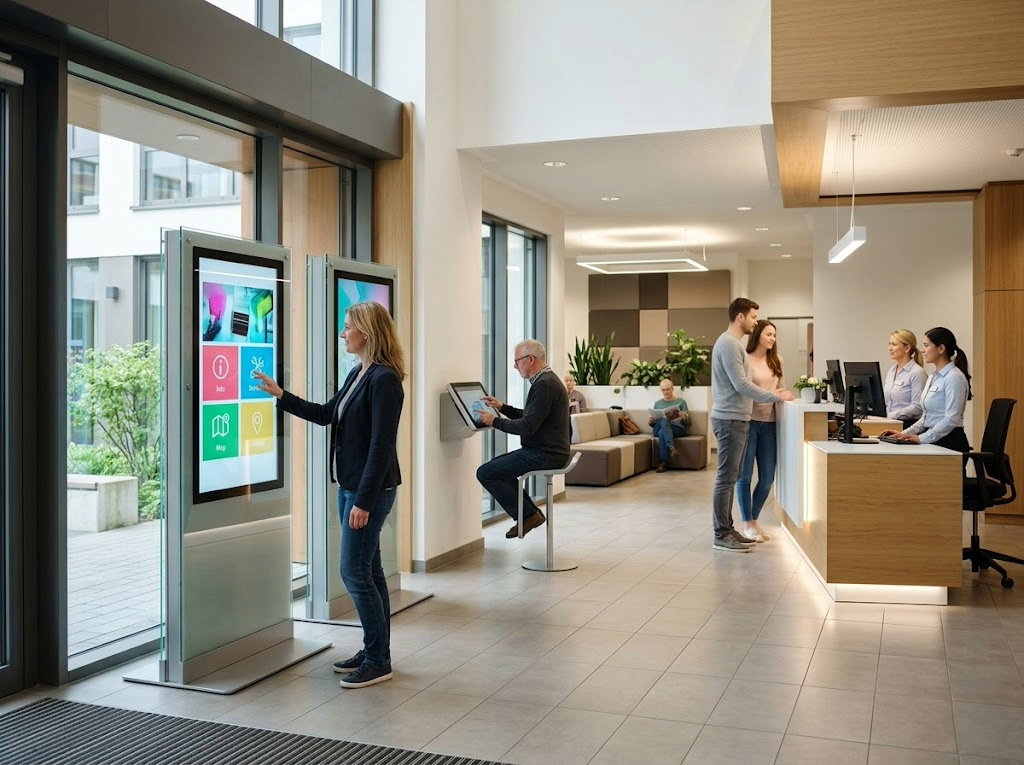
Front office with totems and digital services
Welcoming works better when it provides good information even before the conversation.
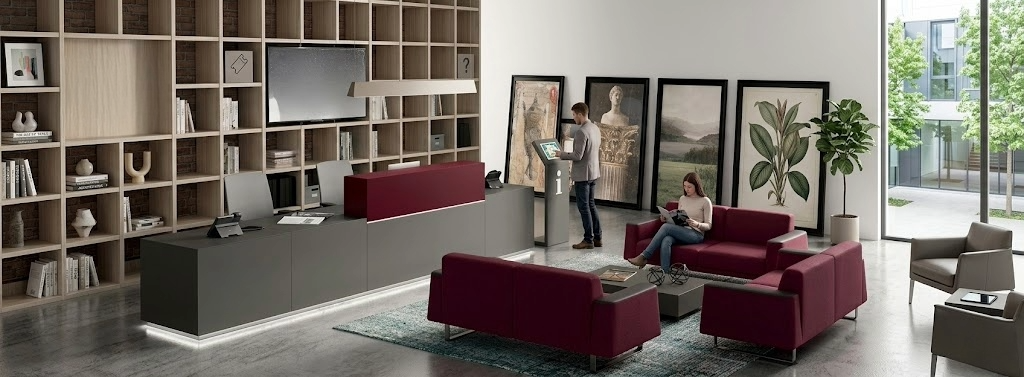
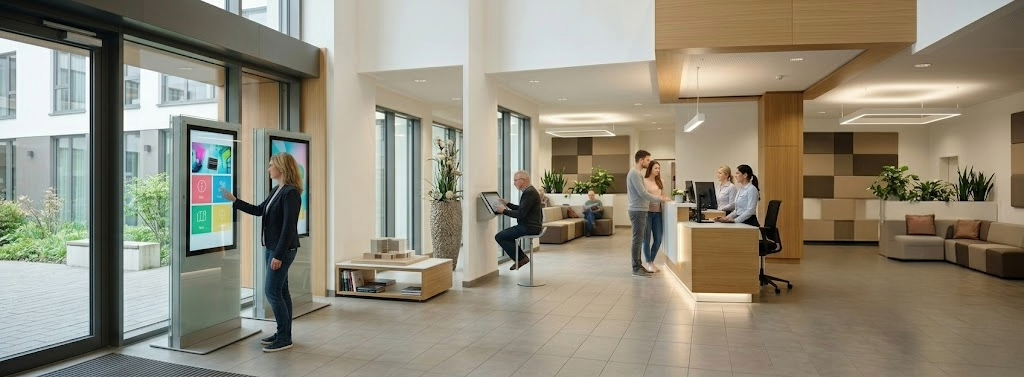
In contemporary front offices, especially in the public sector, it is increasingly useful to integrate information elements that help citizens immediately understand where to go, which services are available and which steps to follow. Information totems, displays, self-service workstations or points for quick content consultation lighten the workload of the main counter and make the experience more autonomous and fluid. This configuration is very effective in services with high footfall or recurring requests, because it makes it possible to filter interactions more effectively and reserve direct conversation for cases that genuinely need it. The result is a more contemporary, more readable front office, better suited to supporting a less dispersive relationship between administration and citizen.
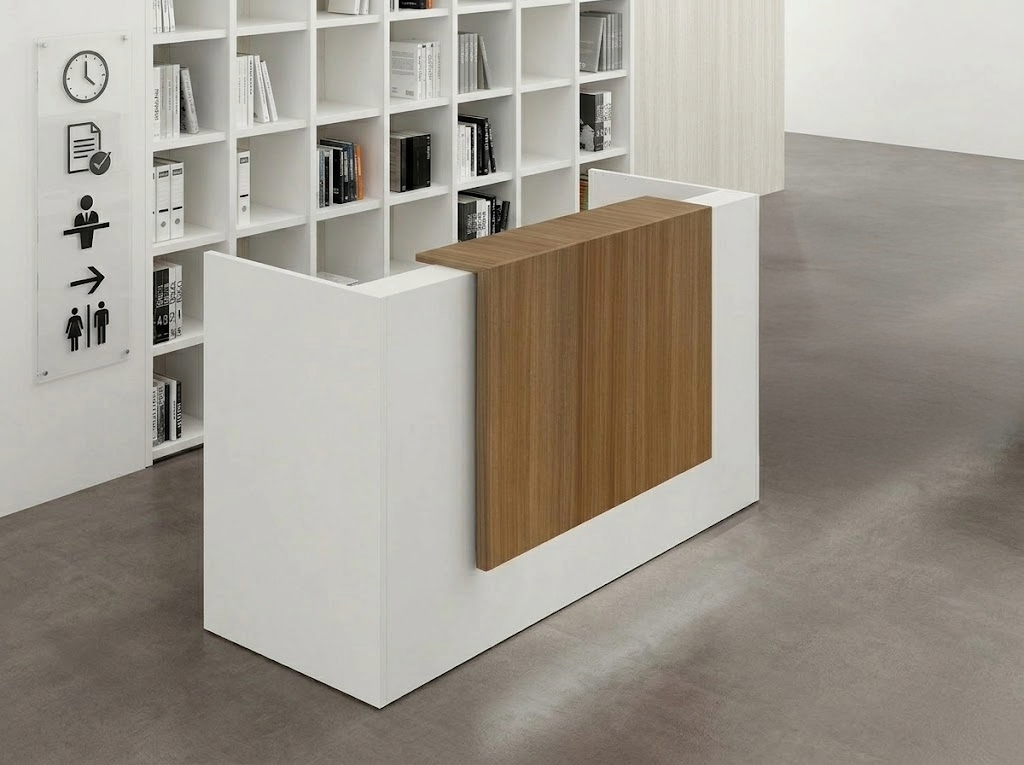
Front office with controlled budget
Even with measured resources, it is possible to create an orderly and credible space.
Not all Public Administration offices can rely on large surfaces or major investments, but this does not mean giving up a clear and professional front office. A controlled-budget solution can work very well if counter, waiting area, signage and operational workstation are selected coherently and correctly proportioned to the space. The difference is not made by the number of elements, but by the way they dialogue with one another and help citizens orient themselves without uncertainty. It is a particularly sensible choice for peripheral branches, temporary offices, decentralised services or gradual environment upgrade projects, where it is important to improve the user experience immediately without making the investment too heavy.
FAQ
An effective front office should include at least a clear welcoming point, a well-organised operational workstation, a readable waiting system and tools that help citizens orient themselves. Depending on the type of service, waiting seating, privacy dividers, signage, information totems or digital solutions that lighten the load on the main counter can be added.
In the Public Administration context, the front office is not simply a reception. It is a true service space, designed to inform, welcome, manage requests, guide citizens and support the work of operators. For this reason, it requires more careful design than a generic entrance, especially in terms of flows, accessibility and clarity of functions.
It is worth doing when footfall is high, services are differentiated or several operators work simultaneously with the public. A multi-counter configuration helps distribute flows better, reduce crowding in front of a single counter and make service organisation more readable for those entering the space.
Yes, because they make the front office clearer and help citizens carry out some steps independently, reducing repeated questions and downtime. They are particularly useful in offices with high footfall or recurring procedures, because they make it possible to filter requests more effectively and enhance operators’ time for activities that truly require direct contact.
Absolutely. Even with a limited investment, it is possible to obtain a more orderly, more professional and easier-to-use space, provided that counter, seating, signage and flows are designed coherently. In many cases, a few well-chosen elements are enough to clearly change the citizen experience and the quality of internal work.